

DSIP 10mg
DSIP 10mg
Couldn't load pickup availability
DSIP 10mg
Get it as soon as -
30 Day Trial
30 Day Trial
We're confident you'll be happy with your order! In case things don't go as planned, you have 30 days to request a refund based on our return and refund policy.
Shipping & Processing
Shipping & Processing
Our shipping services are designed to be fast and reliable, ensuring your order is delivered promptly. Please allow 5-10 business days for delivery.
Track My Order
Track My Order
Once your order is shipped, we will provide you with a tracking number to monitor the progress of your shipment on our website or the shipping carrier's website. You can track your order here Track My Order
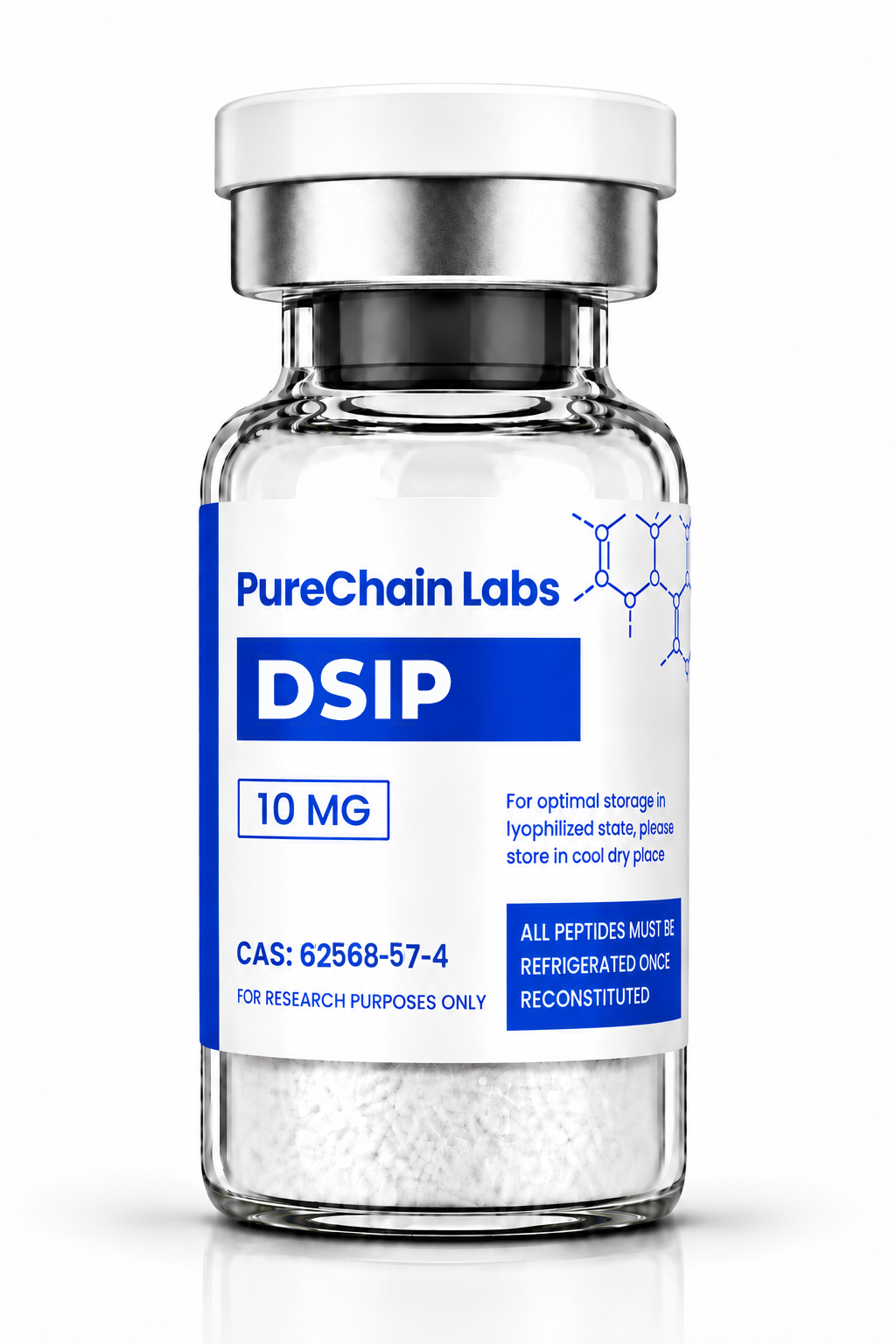
Each vial contains 10mg of lyophilized DSIP.
DSIP (delta sleep-inducing peptide) is a synthetic nine-amino-acid peptide first isolated from rabbit brain. Researchers use it to study sleep regulation, daily body rhythms, and hormone signalling.
When reconstituted with 1mL of bacteriostatic water, DSIP yields a solution of 10mg/mL.
Before reconstitution, this product is stable at room temperature for short periods, such as during shipping, but refrigeration is recommended for longer-term storage. After reconstitution, it must be refrigerated. Keep away from direct light. This product is stored refrigerated until it ships.
Bacwater is free with any vial.
Canadian Based
01The PureChain Standard
Purity And Documentation
Your results are only as good as the compound you start with.
Every vial is labelled with its compound, vial size and molecular weight, and ships for laboratory research use only. Third-party testing details will be published here.
Supplied for in-vitro laboratory research only. Not for human or veterinary use, and not intended to diagnose, treat, cure or prevent any disease.
- Size
- 10mg
- Form
- Lyophilized powder
- Storage
- −20 °C, protected from light
- Molar mass
- 848.8 Da
About This Compound
About DSIP
DSIP, short for delta sleep-inducing peptide and also known by the name emideltide, is a nine-residue neuropeptide - Trp-Ala-Gly-Gly-Asp-Ala-Ser-Gly-Glu. It was first described in 1977 by researchers working with rabbits in which sleep had been induced by electrical stimulation, and it takes its name from the slow-wave, or delta, sleep it was associated with in those early experiments. Decades later its biology is still only partly mapped: no dedicated receptor has been identified, and the peptide is studied as much for its reported links to circadian timing and stress-hormone signalling as for sleep itself. PureChain Labs supplies DSIP as a lyophilised powder for in-vitro laboratory research only.
Neuropeptide
Molecular Formula
Molecular Weight
Form
CAS Number
02Molecular Structure
The DSIP molecule
An illustrative atomic representation generated from the compound record, alongside its verified molecular data. The structure figure is schematic – not a measured conformation.
- C
- H
- N
- O
- S/P
Molecular data from the public PubChem record (CID 68816). View on PubChem
By The Numbers
DSIP Research, By The Numbers
The figures that define DSIP and how it is being studied. For laboratory research use only.
Amino Acids
Trp-Ala-Gly-Gly-Asp-Ala-Ser-Gly-Glu
First Described
Isolated in sleep research on rabbits
Molecular Weight (g/mol)
C35H48N10O15, PubChem CID 68816
Research Areas
- Sleep Architecture
- Circadian Rhythm Studies
- Neuroendocrine Signalling
- Stress-Response Research
How It Works
How DSIP Works
The pathways DSIP acts on, and what each one does. Described from preclinical and receptor-pharmacology literature.
The Original Observation
DSIP was named for the delta (slow-wave) sleep observed in the animal work that first isolated it. Later studies reported mixed and model-dependent results, so its role in sleep is treated in the literature as modulatory rather than as a simple sleep switch.
- Named for slow-wave (delta) sleep
- Effects reported as model-dependent
- Studied with EEG sleep-stage readouts
Hormone Signalling Links
Published work has examined DSIP alongside pituitary and hypothalamic hormones, including reported interactions with corticotropin and luteinising-hormone release in animal models. These are investigated as signalling relationships, not as established mechanisms.
- Studied alongside hypothalamic-pituitary hormones
- Stress-hormone interactions reported in animal models
- Mechanism still under investigation
No Identified Receptor
Unlike most neuropeptides, DSIP has no cloned, dedicated receptor. That gap is a large part of why it remains a research compound: how a nine-residue peptide produces the effects reported for it is itself the subject of study.
- No dedicated receptor identified
- Mode of action not established
- Findings are specific to the model used
Uses And Applications
What DSIP Is Researched For
The main areas DSIP is studied in, and the qualitative magnitudes reported alongside them.
Sleep Architecture
The founding research use - EEG-based studies of slow-wave sleep and sleep-stage distribution in animal models.
Circadian Rhythm Studies
Investigated for links to daily rhythms in activity, body temperature and hormone secretion.
Neuroendocrine Signalling
Used to probe interactions with hypothalamic and pituitary hormone release in laboratory models.
Stress-Response Research
Studied in models of physiological stress, where reported effects on stress-hormone signalling are the measured endpoints.
Compound Information
Full Specification
| Chemical Name | Delta Sleep-Inducing Peptide (Emideltide) |
|---|---|
| Sequence | H-Trp-Ala-Gly-Gly-Asp-Ala-Ser-Gly-Glu-OH |
| Molecular Weight | 848.8 Da |
| Molecular Formula | C35H48N10O15 |
| CAS Number | 62568-57-4 |
| Form | Lyophilized powder |
| Solubility | Water-soluble |
| Storage | Store lyophilized at −20 °C, protected from light and moisture |
| Vial Size | 10mg |
| PubChem CID | 68816 |
FAQ
Common Questions About DSIP
What Is DSIP?
Delta sleep-inducing peptide, a nine-residue neuropeptide also known as emideltide. PubChem lists it under CID 68816 with the formula C35H48N10O15, a molecular weight of 848.8 g/mol and CAS number 62568-57-4.
Where Does The Name Come From?
From the delta, or slow-wave, sleep associated with it in the 1977 rabbit studies that first isolated it. The name describes that original observation, not a confirmed mechanism.
Does DSIP Have A Known Receptor?
No dedicated receptor has been identified. How DSIP produces the effects reported for it is still an open research question.
What Is DSIP Researched For?
Sleep architecture, circadian rhythms, neuroendocrine signalling and stress-response research, mostly in animal and in-vitro models.
Is DSIP Approved For Human Use?
No. Nothing supplied by PureChain Labs is approved for human use or sold for it. This material is supplied as a research chemical for in-vitro laboratory work only.
How Should Research-Grade DSIP Be Stored?
As supplied it is a lyophilised powder; the vial directs storage in a cool, dry place in the lyophilised state, and refrigeration once reconstituted.
Feedback
WHAT OUR CUSTOMERS HAVE TO SAY...
"Been using PureChain Labs for 9 months now. In my opinion, it's the best source in Canada. Quality product every time and gives me the best results. Also the communication is second to none, I get a response in minutes usually. Overall extremely happy with the service and product they provide."
"A+ service and communication. Delivery is always quick and packaged safe and sound... I love how they are transparent and you know what your getting and for using a new source for the first time that's a huge relief."
"Took a month but hair felt thicker at roots, gave me hope after months of thinning, they definitely sell quality peptides."
Not for human or veterinary use. For in-vitro laboratory research only. These statements have not been evaluated by the FDA or Health Canada; this product is not intended to diagnose, treat, cure or prevent any disease.